

Every poker machine in an Australian pub, club or casino has to be built to return at least a set percentage of turnover to players over its life. The figure is not national: the Australian/New Zealand Gaming Machine National Standard (Revision 12.1, May 2025) lists a minimum return to player (MINRTP) of 85% for NSW, Queensland, Victorian clubs and hotels and the Northern Territory, 87% for the ACT, Tasmania and the Victorian casino, 87.5% for South Australia and 90% for the casino in Western Australia.
- The national standard (Revision 12.1, May 2025) sets MINRTP at 85% for NSW, Queensland, NT and Victorian clubs and hotels.
- South Australia sits at 87.5%, the ACT and Tasmania at 87%, and the WA casino at 90%.
- Queensland clubs and hotels also have a maximum RTP of 92%; Victoria caps at 99.99%.
- No Australian minimum applies to online slots, because offering online pokies to people in Australia is prohibited under the Interactive Gambling Act 2001.
On this page
- What a minimum return to player actually means
- The table: minimum and maximum RTP by jurisdiction
- Where the state rules come from
- Why figures quoted online often disagree
- What the floor does not tell you
- A worked example: what five points of RTP mean in dollars
- Online slots: outside the state system altogether
- Reading the information screen
- Questions readers ask
- Sources
What a minimum return to player actually means
Return to player (RTP) is the share of all money bet on a game that the game is designed to pay back as prizes over a very long run of play. A pokie with an RTP of 85% is expected to pay back $85 for every $100 put through it, across millions of games and many players. The remaining $15 is the theoretical hold. It is not a promise about any one session: a single player can win or lose far more than that in an evening.
Queensland's Gaming Machine Act 1991 is typical in how it frames the idea. Section 11 defines the percentage return to player for a game by reference to the amount that would be bet if bets were made on every result in the game, and the amount that could be won, other than promotions, if all winning results were obtained. In other words, RTP is a property of the game's maths, calculated in a laboratory before the machine is approved, not something measured after the event.
The technical rule that ties this to a legal floor is clause 4.15 of the Australian/New Zealand Gaming Machine National Standard. It says a game must have a theoretical or estimated statistical expectation that its minimum RTP will be greater than or equal to [MINRTP]. The bracketed value is left blank in the body of the standard and filled in, jurisdiction by jurisdiction, in Appendix B, Limits and Parameters. Each state's regulator then adopts the national standard with its own appendix.
The table: minimum and maximum RTP by jurisdiction
The figures below are taken from Appendix B of Revision 12.1 of the national standard, dated May 2025 and published by the Victorian Gambling and Casino Control Commission. Where the standard lists separate values for casinos and for clubs and hotels, both are shown.
| Jurisdiction and venue type | Minimum RTP | Maximum RTP | Maximum bet |
|---|---|---|---|
| NSW | 85.00% | Not specified | $10 ($100 on multi-terminal machines) |
| ACT | 87.00% | Not specified | $10 |
| South Australia, clubs and hotels | 87.50% | Not specified | $5 |
| South Australia, casino | 87.50% | Not specified | $5 outside premium gaming areas |
| Northern Territory, clubs and hotels | 85.00% | Less than 100% | $5 |
| Northern Territory, casinos | 85.00% | Less than 100% | No limit |
| Tasmania | 87.00% | Not specified | $5 |
| Western Australia, casino | 90.00% | 100% | No more than $10 in aggregate per play on the main gaming floor |
| Queensland, clubs and hotels | 85.00% | 92.00% | $5 |
| Queensland, casinos | 85.00% | Not specified | Not specified |
| Victoria, clubs and hotels | 85.00% | 99.99% | $5 |
| Victoria, casino | 87.00% | 99.99% | $10 unless operating in unrestricted mode in a specified area |
Three things stand out. The spread between jurisdictions is narrow, five percentage points from the lowest floor to the highest. Queensland is the only jurisdiction in the table that also caps RTP from above for pubs and clubs, at 92%. And Western Australia has a single casino column because, as the state's Department of Local Government, Sport and Cultural Industries says, the location of electronic gaming machines in WA is restricted to Crown Perth, with poker machines of the kind found in eastern-state suburban venues prohibited.
Where the state rules come from
The national standard is a technical document; its values only bind because each regulator adopts them. Some jurisdictions also restate the floor in their own instruments.
- Tasmania. The Tasmanian Liquor and Gaming Commission's Tasmanian Gaming Machine Standards, in the version dated 6 July 2026, state at clause 3.8.1 that the minimum return to player percentage configured and operated on a gaming machine must not be less than 87%.
- Victoria. The VGCCC's Victorian Appendix to the national standard (version 3.0, approved December 2025) lists additional Victorian requirements and points back to Appendix B of the national standard for the Victorian parameters, which is where the 85% and 87% figures sit.
- ACT. Gaming machine approvals published on the ACT legislation register show the floor in action: some low-return game variations are approved only on a linked jackpot arrangement where the combined machine and link percentage return to player is at least 87%.
- Queensland. Section 283 of the Gaming Machine Act 1991 lets a licensee or licensed monitoring operator change the percentage return to players for an approved game, but section 35 of the Gaming Machine Regulation 2002 sets a restricted period of one month after the last change, and making a change inside that period carries a maximum penalty of 200 penalty units.
Why figures quoted online often disagree
Search for pokie minimums and you will find conflicting numbers. Secondary summaries put the Queensland casino floor at 90%, while the national standard's Appendix B lists 85% for Queensland casinos. Older guides often say Victoria requires 87% everywhere; Community Clubs Victoria explains that the minimum was historically 87% and that from April 2014 a club could choose to go down to 85%, which matches the current 85% clubs-and-hotels figure and the 87% Victorian casino figure in Appendix B.
The safest reading is the current revision of the national standard plus the state appendix, because that is what laboratories test against. Where this guide could not find a primary document for a figure, it has been left out rather than guessed.
What the floor does not tell you
A legal minimum is only a floor. Venues and manufacturers can run games above it, and the same game can be approved at more than one return. The national standard deals with this in several ways:
- Bet options. Clause 4.17 says that, within a single game variation, changing the bet options must not change the theoretical RTP by more than 0.20%.
- Ranges must be shown. Under clause 4.52, if a game operates with more than one RTP or a range of RTPs, the range must be displayed in the electronic game information.
- Linked jackpots. Clause 4.51 requires a machine on a linked jackpot to show the total return, being the game's own return plus the share contributed to the jackpot, and the jackpot's contribution separately.
Tasmania's standards add that games with different RTPs for different bet options must display the range or the lowest RTP, and that ante-bet games with a different RTP in each mode must show both unless the difference is less than 0.25%. The practical lesson: on a land-based pokie the RTP is in the game information screen, and it may be a range rather than one number.
A worked example: what five points of RTP mean in dollars
The example below uses round, illustrative numbers. It shows the theoretical cost of the same amount of play at different returns; real sessions vary widely around these figures.
| Return to player | Turnover (1,000 spins at $1) | Expected return | Expected cost |
|---|---|---|---|
| 85% (NSW, QLD, VIC clubs floor) | $1,000 | $850 | $150 |
| 87.5% (SA floor) | $1,000 | $875 | $125 |
| 90% (WA casino floor) | $1,000 | $900 | $100 |
| 96.5% (example online slot) | $1,000 | $965 | $35 |
The key point is that cost scales with turnover, not with the deposit. Someone who puts $100 into a machine and keeps re-betting their wins can easily turn it over ten times, which is why a few points of RTP matter more than they first appear to.
Online slots: outside the state system altogether
None of these minimums applies to online slots. Under the Interactive Gambling Act 2001, providing a prohibited interactive gambling service, which includes online casino games and online pokies, to customers physically present in Australia is a breach; the ACMA describes subsection 15(2A) as the civil penalty provision it enforces. The Act targets the operators and advertisers. It does not make it an offence for an individual to play, but the ACMA warns that Australians who use illegal gambling services are not protected by Australian laws, including when a provider withholds winnings.
That means there is no Australian regulator checking the RTP of a slot on an offshore site. The return is whatever the game studio built and the operator chose to run. Studios publish their own figures: Pragmatic Play lists Gates of Olympus at 96.50% and Wolf Gold at 96.01%. Some studios publish several versions of the same game. Hacksaw Gaming, for example, lists Wanted Dead or a Wild at 96.38%, 94.55%, 92.33% and 88.42%. Which one a given casino runs is the casino's choice, which is why the in-game information screen matters more than any headline figure. The companion article on slot RTP versions explains how to find the active figure.
Higher theoretical returns on paper are also not the same as protection. A land-based pokie sits under a state regulator, a monitoring system and a complaints process. An offshore slot sits under whatever licence the operator holds, if any. The Australian law overview covers the legal position in more detail, and the pokies guide explains volatility and features.
Reading the information screen
For a land-based machine, the electronic game information required by the national standard should show the RTP or its range, the average number of games per win, the odds of the top five and bottom five winning combinations, and for linked jackpots the total return. For an online slot, look in the help or paytable screen for a sentence such as "the theoretical RTP of this game is" followed by a figure, and compare it with the studio's published versions.
If gambling is costing more than intended, free and confidential support is available from Gambling Help Online on 1800 858 858, and the responsible gambling page lists further tools. BetStop, the national self-exclusion register, covers licensed Australian wagering services.
Questions readers ask
What is the minimum return on pokies in NSW?
Appendix B of the Australian/New Zealand Gaming Machine National Standard, Revision 12.1, lists a minimum return to player of 85.00% for NSW.
Which state has the highest minimum pokie return?
Western Australia's casino column in the national standard shows 90.00%, the highest floor in the table. Among jurisdictions with pubs and clubs, South Australia is highest at 87.50%.
Does Queensland cap how much a pokie can pay back?
Yes. The national standard lists a maximum RTP of 92.00% for Queensland clubs and hotels, alongside the 85.00% minimum.
Do Australian minimum RTP rules apply to online slots?
No. Offering online pokies to people in Australia is prohibited under the Interactive Gambling Act 2001, so no Australian regulator sets or tests the RTP of slots on offshore sites. The return is set by the studio and the operator's choice of version.
Sources
Every figure and date in this article comes from the documents below; we re-check them when a source changes.
- Australian/New Zealand Gaming Machine National Standard, Revision 12.1 (May 2025), hosted by VGCCC
- VGCCC: Victorian Appendix to the Gaming Machine National Standard
- Tasmanian Liquor and Gaming Commission: Tasmanian Gaming Machine Standards, 6 July 2026
- Queensland Gaming Machine Act 1991 (ss 11, 283)
- Queensland Gaming Machine Regulation 2002 (s 35)
- ACT Gaming Machine and Peripheral Equipment Approval 2005 (No 3)
- WA DLGSC: $10 betting cap on EGMs at Crown Perth
- Community Clubs Victoria: Return to Player
- ACMA: Formal warning under subsection 15(2A) of the Interactive Gambling Act (2 September 2026)
- ACMA: Latest illegal online gambling websites blocked
- Pragmatic Play: Gates of Olympus
- Pragmatic Play: Wolf Gold
- Hacksaw Gaming: Wanted Dead or a Wild
 MarketsPayID vs Osko vs PayTo vs the NPP: who does what, and why casino deposits look differentFour names for parts of Australia's real-time payment system, what each one actually does, and what changes when the payee is an offshore casino.7 min read
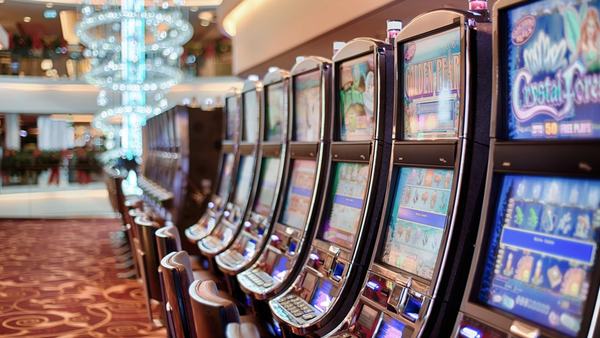 MarketsHold & Spin, Hold and Win, Money Respin: how studios name the same pokie bonusLightning Link popularised the hold-and-respin jackpot bonus. Patents and trade marks explain why rival studios give the same idea different names.7 min read
 RegulationBetStop explained: periods, removal rules, provider duties and the gap it leaves for offshore casinosWhat the national self-exclusion register does, how long it lasts, how to leave it, and why it has no reach over illegal offshore casino sites.7 min read